Shape Isn't a Plan
People think recognition is the finish line.
It's not. It's the doorway.
If you can see the court but can't read the defense, you're still guessing.
The Problem With "Algorithm-First"
Most developers don't read a problem.
They decide.
A method. A structure. A move. Then they go hunting for evidence that supports the decision they already made.
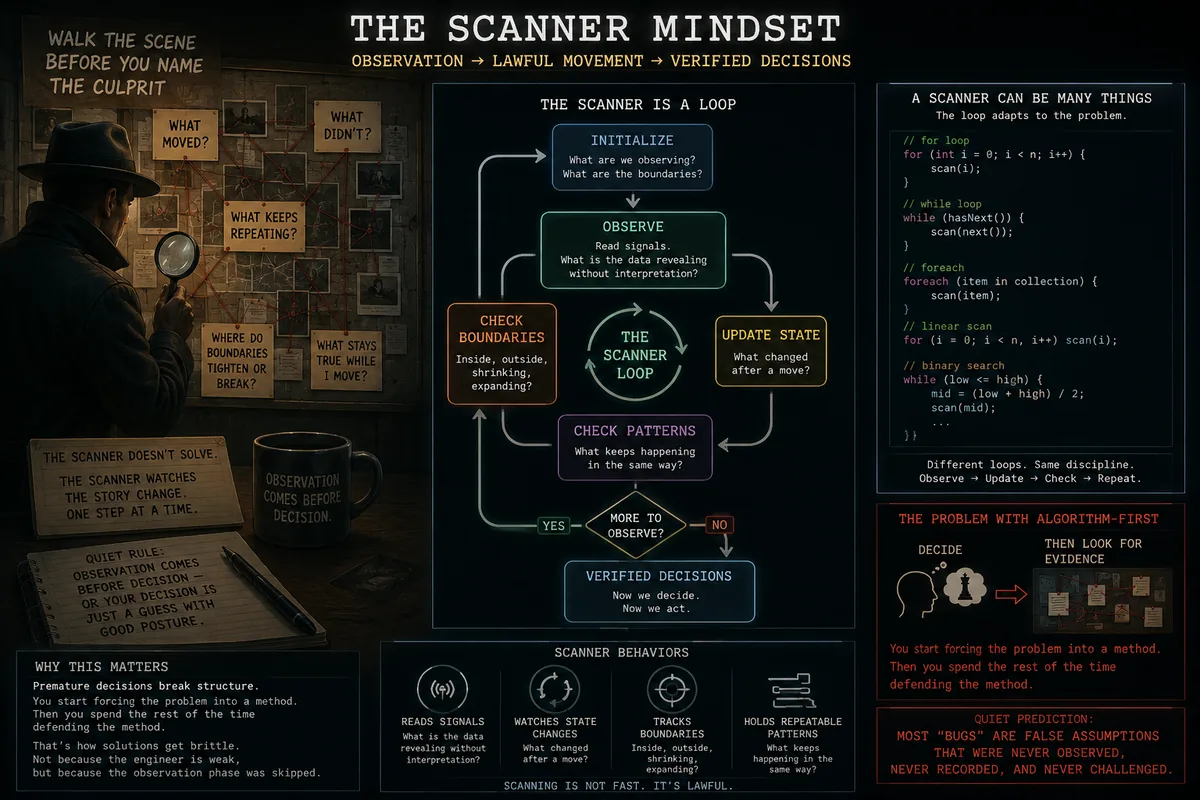
- What changes when I move?
- What stays true while I move?
- Where do boundaries tighten or break?
- What pattern repeats without my permission?
The Scanner Doesn't Solve
The Scanner isn't there to be clever.
It doesn't argue. It doesn't predict. It doesn't "assume this is a two pointer."
The Scanner watches the story change. One step at a time.
Walk the Scene Before You Name the Culprit
When I step into a scene, I don't start with a theory.
I start with what moved. What didn't. What keeps repeating even when nobody's looking.
A detective doesn't solve by guessing the ending. He solves by watching the truth leave fingerprints in the room.
What the Scanner Actually Does
The Scanner is a disciplined witness. It watches the same few things every time.
- Reads signals. What is the data revealing without interpretation?
- Watches state changes. What changed after a move?
- Tracks boundaries. What is inside, outside, shrinking, expanding?
- Holds repeatable patterns. What keeps happening in the same way?
Scanning is not fast. It's lawful.
Why This Matters
Premature decisions break structure.
You start forcing the problem into a method. Then you spend the rest of the time defending the method.
That's how solutions get brittle. Not because the engineer is weak - because the observation phase was skipped.
Ron Snow Observation
The best moves don't show up in loud moments.
They show up after quiet observation.
When you can describe the motion without guessing, the method stops feeling like a trick. It starts feeling like the only legal move left.
What Comes Next
The Scanner sees movement.
But seeing isn't enough. Something has to confirm what's true - and keep the truth from drifting.
Next entry: The Recorder. That's where we talk about capturing valid results - the receipt you can stand on when the problem starts shifting again.
Book Zero - The Entry Point Into Correct Code
The Tri-Angle Offense teaches you how to think differently. Book Zero teaches you how to begin applying that thinking.
This is not a textbook. It's a mental reset - a detective-style introduction to algorithmic reasoning, designed to shift how you see problems before you ever write code.
- Learn the mindset behind the CCF Framework
- Understand why reasoning beats memorization
- Step into the Ron Snow universe