Shape Isn't a Plan
People think recognition is the finish line.
It's not. It's the doorway.
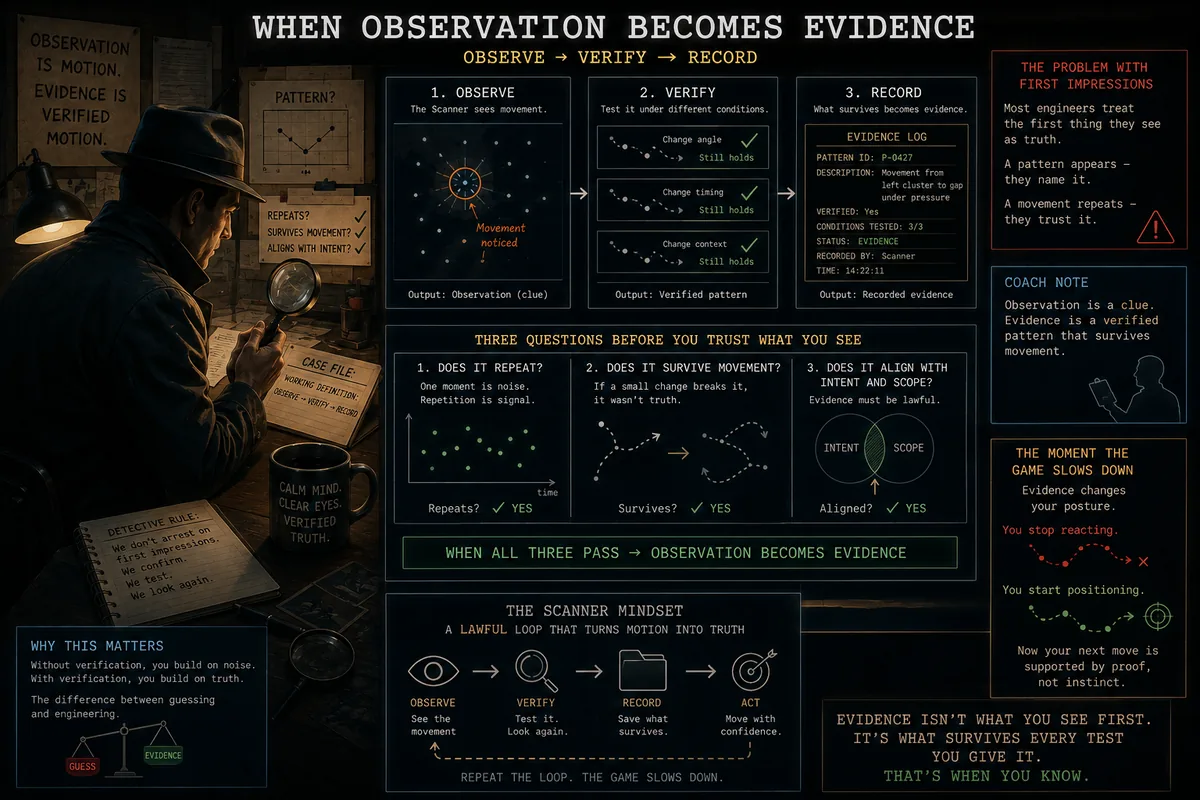
If you can see the court but can't read the defense, you're still guessing.
The Problem With First Impressions
Most engineers treat the first thing they see as truth.
A pattern appears - they name it. A movement repeats - they trust it.
Observation is a clue. Evidence is a verified pattern that survives movement.
The Detective Rule
Detectives don't arrest people based on what they notice first.
They confirm. They test. They look again under different light.
Engineering works the same way. The Scanner notices movement - but verification decides what becomes real.
Three Questions Before You Trust What You See
- Does it repeat? One moment is noise. Repetition is signal.
- Does it survive movement? If a small change breaks it, it wasn't truth.
- Does it align with intent and scope? Evidence must be lawful.
When those three pass - observation becomes evidence.
The Moment the Game Slows Down
Evidence changes your posture.
You stop reacting. You start positioning.
This is where calm engineering begins - because now your next move is supported by proof, not instinct.
Ron Snow Observation
Most people think engineers fail because they didn't see enough.
They fail because they trusted what they saw too early.
What Comes Next
The Scanner observes. Evidence verifies. The Recorder preserves.
Next entry: The Recorder - where truth stops drifting and structure becomes stable.
Book Zero - The Entry Point Into Correct Code
The Tri-Angle Offense teaches you how to think differently. Book Zero teaches you how to begin applying that thinking.
This is not a textbook. It's a mental reset - a detective-style introduction to algorithmic reasoning, designed to shift how you see problems before you ever write code.
- Learn the mindset behind the CCF Framework
- Understand why reasoning beats memorization
- Step into the Ron Snow universe