Why "Plays" Keep Failing
When people hear "algorithm," they start reaching for a move. A technique. A play. But the play only works when the space is right.
That's why isolation thinking collapses under pressure. It's not wrong - it's incomplete. You can be "right" and still lose, because you're solving the moment instead of controlling the space.
In the Tri-Angle, the goal isn't to memorize a move. It's to build a position where multiple legal moves exist at the same time.
The CCF Tri-Angle: Route - Scope - Intent
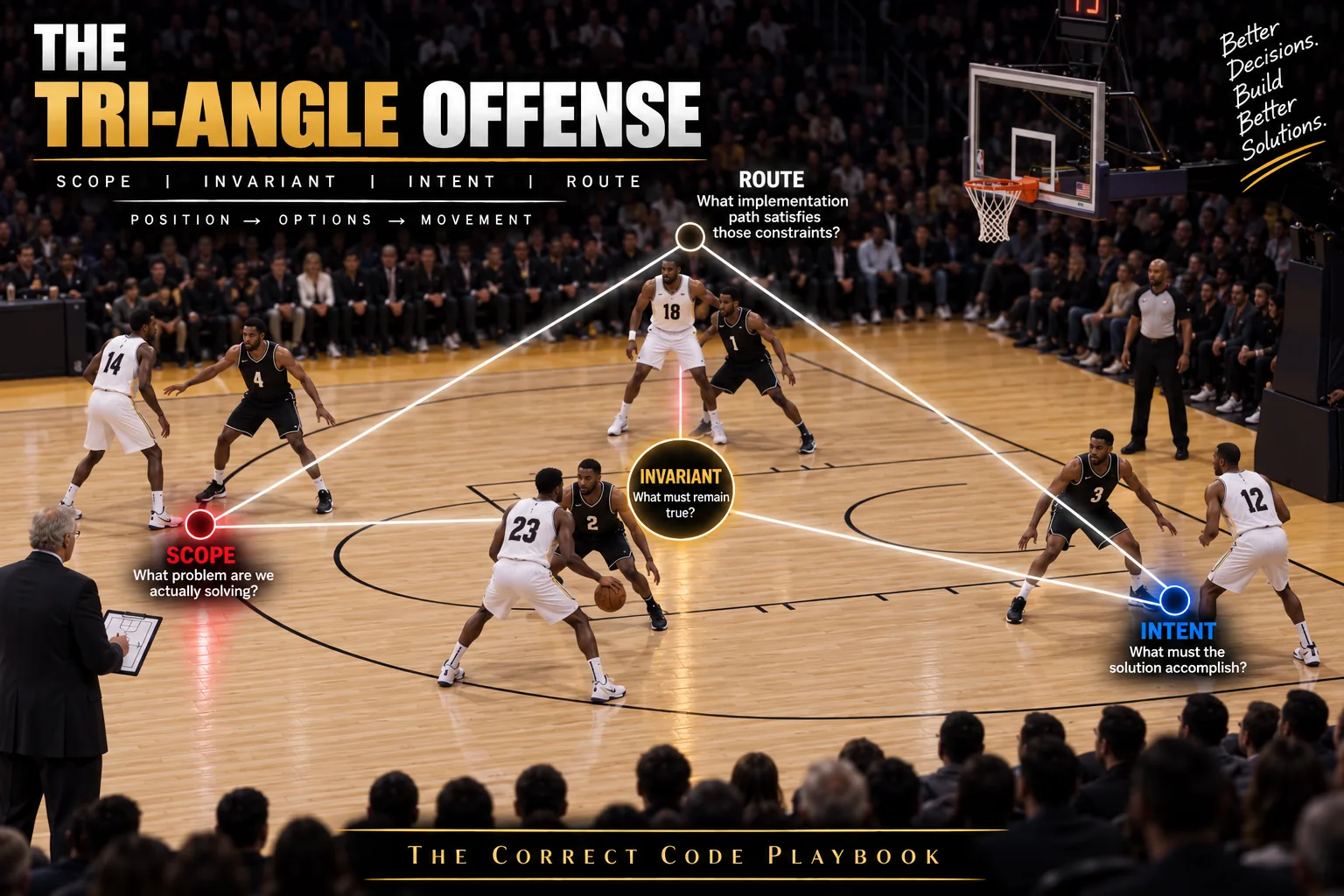
The CCF Tri-Angle is a positioning model. Scope defines the problem, Intent defines the goal, and Route defines the lawful path between them. At the center is the Invariant - the condition that must remain true as the solution moves. Every correct solution is a legal movement through these forces without violating the Invariant.
What must the solution accomplish? Intent defines the goal or finish line - the result the solution must produce.
What problem are we actually solving? Scope defines the boundaries of the problem and limits what belongs in the answer space.
What must remain true throughout the solution? The Invariant is the condition that must be preserved while the solution moves from the starting state toward the intended result.
What implementation path satisfies those constraints? Route is the lawful movement through the problem space - the operations and transitions that preserve the Invariant while progressing toward the Intent.
The three points remain Scope, Intent, and Route; the Invariant holds the center as the condition every movement must preserve. If you can't position them, you don't have a plan - you have motion. The CCF Tri-Angle turns motion into decisions.
Plan Before You Code
Picture a courtroom. Everybody has a story, but the judge only cares about what can be proven. The CCF Tri-Angle is how you prepare the case before you walk into the room.
- Intent: the verdict you're asking for.
- Scope: what evidence is admissible (and what isn't).
- Invariant: the rule of proof that must remain satisfied throughout the argument.
- Route: the order you present facts so the case stays coherent.
You don't win by talking faster. You win by controlling what counts.
What Comes Next
The CCF Tri-Angle doesn't tell you what algorithm to use. It teaches you how to position yourself so the algorithm becomes inevitable.
Next entry: Movement That's when you stop guessing moves - and start seeing structure.
Book Zero - The Entry Point Into Correct Code
The CCF Tri-Angle Offense teaches you how to think differently. Book Zero teaches you how to begin applying that thinking.
This is not a textbook. It's a mental reset - a detective-style introduction to algorithmic reasoning, designed to shift how you see problems before you ever write code.
- Learn the mindset behind the CCF Framework
- Understand why reasoning beats memorization
- Step into the Ron Snow universe